13 Best Games Like The Legend of Zelda to Play in 2026
Finding a game that captures the soul of Hyrule is no easy feat. Whether you’re chasing the high of conquering a complex dungeon or the quiet awe of seeing a distant landmark and realizing you can actually go there, that “Zelda itch” is notoriously hard to scratch.
While Nintendo’s flagship series remains the gold standard, other developers have spent years refining their own unique takes on this legendary formula. From physics-based open worlds to cryptic top-down adventures, the landscape is now filled with incredible Games Like The Legend of Zelda.
This list dives into the absolute best alternatives that respect Link’s legacy while carving out their own unique paths, ensuring your next great adventure is just a download away.
The Open-World Successors (Modern Zelda Vibes)
1. Immortals Fenyx Rising
If you’ve spent any time with Breath of the Wild, you’ll feel immediately at home in Immortals Fenyx Rising. Ubisoft Quebec essentially took the systemic DNA of modern Zelda—climbing any surface, gliding across vistas, and physics-driven environmental puzzles—and gave it a vibrant, sarcastic Greek mythology makeover.
You play as Fenyx, a customizable hero tasked with saving the gods from the titan Typhon. The game’s “Vaults of Tartaros” function almost exactly like Shrines, offering bite-sized challenges that test your logic and platforming skills. While it leans harder into combo-based brawler combat and narrational humor, it stands out as one of the most polished Games Like The Legend of Zelda for players who want that specific “see it, go there” sense of freedom.
It’s accessible, dense with secrets, and replaces weapon durability with a satisfying gear progression system that many Zelda fans actually prefer.
2. Elden Ring
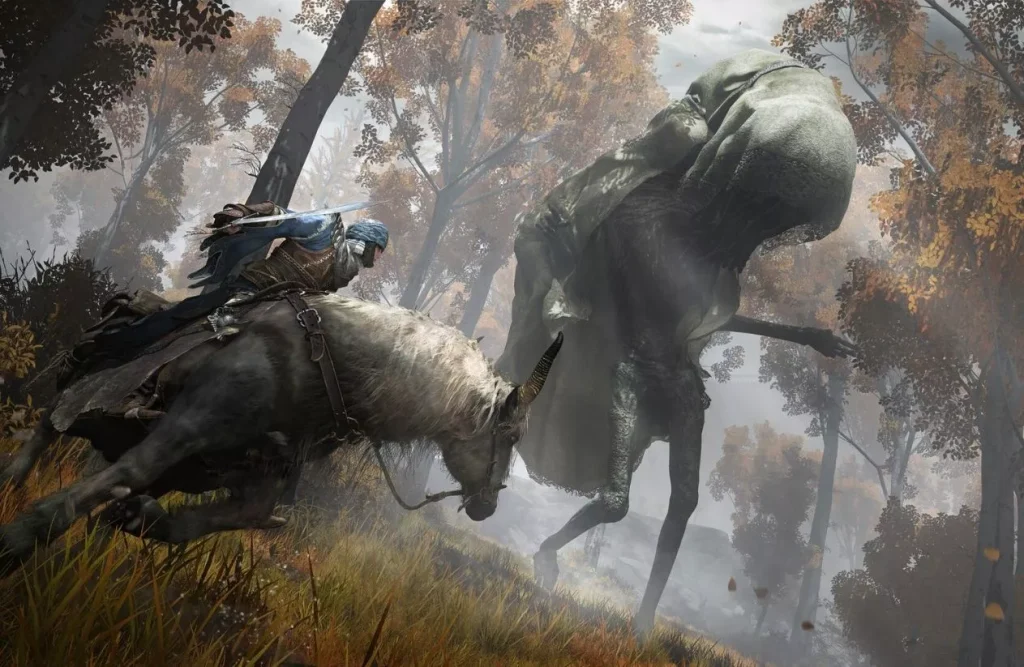
It might seem strange to compare a “Soulsborne” title to a Nintendo classic, but Elden Ring is effectively a dark, mature evolution of the Tears of the Kingdom philosophy.
Both games share a radical commitment to player agency; if you see a tower on the horizon or a massive crater in the ground, you can simply ride over and explore it without a dozen quest markers cluttering your screen.
As a game similar to Legend of Zelda, Elden Ring trades the bright colors and physics puzzles for high-stakes combat and deep lore. The “Legacy Dungeons”—massive, interconnected castles like Stormveil—are essentially the high-budget versions of classic Zelda dungeons, filled with shortcuts, hidden keys, and formidable bosses.
While the difficulty curve is much steeper, the sense of wonder you feel when stepping into a new region for the first time is unmatched. For those who loved the “go anywhere” freedom of Link’s latest outings but wanted a world that felt dangerous and mysterious, this is the ultimate recommendation.
3. Genshin Impact
When Genshin Impact first debuted, the comparisons to Breath of the Wild were unavoidable. From the stamina-depleting climbing and hang-gliding to the watercolor aesthetic of its sprawling meadows, it wears its inspiration on its sleeve. However, beneath the surface lies a highly complex game similar to Legend of Zelda that pivots from solo adventuring to a team-based RPG experience.
The biggest draw for Zelda fans is the elemental chemistry. Much like how Link uses fire to create updrafts or ice to cross water, Genshin’s combat revolves around “Elemental Reactions.” You might use a character to drench an enemy with water, then swap to an electric user to trigger a “Charged” reaction that zaps nearby foes.
The world-building is equally massive, with distinct nations based on real-world cultures, each hiding hundreds of chests and environmental puzzles. While it does feature “gacha” mechanics for unlocking new characters, the base exploration and story are entirely free, offering a high-quality open-world fix for anyone missing the rolling hills of Hyrule.
The Retro & Top-Down Homages (Classic Zelda Vibes)
4. Tunic
If your favorite Zelda memory involves sitting on the floor with an NES controller and a confusing instruction booklet, Tunic was made specifically for you. At first glance, it looks like a cute, isometric tribute where you play as a fox in a familiar green tunic. But start playing, and you’ll realize it’s actually a genius puzzle box that weaponizes your nostalgia.
The game’s most brilliant mechanic is the in-game manual. You collect it page by page as you explore, but most of it is written in a cryptic, made-up language. You have to decipher illustrations and maps to figure out basic mechanics—like how to upgrade your stats or what that strange altar actually does.
It captures that authentic 1980s feeling of “mystery” that modern tutorials often kill. While the combat has a bit of “Souls-like” difficulty with stamina management and dodge rolls, the spirit is pure, old-school Zelda exploration.
5. Death’s Door
While Tunic leans into mystery, Death’s Door masters the “lock-and-key” dungeon design that defined the 16-bit era. You play as a sword-wielding crow with a bureaucratic desk job: reaping souls. The premise is charmingly grim, but the gameplay loop is pure comfort food for A Link to the Past fans.
The game is structured around a central hub leading to distinct, thematic regions—a ceramic manor, an overgrown forest, a flooded fortress—each culminating in a massive dungeon and boss fight.
As you progress, you unlock classic tools like a hookshot and bomb spell (reimagined as magic abilities) that let you backtrack and open previously inaccessible paths.
The combat is snappier and faster than traditional Zelda, rewarding aggression and dodge-rolling, but it never feels unfair. It’s a tight, 10-hour adventure with zero filler, proving you don’t need an open world to have a grand adventure.
6. Blossom Tales: The Sleeping King
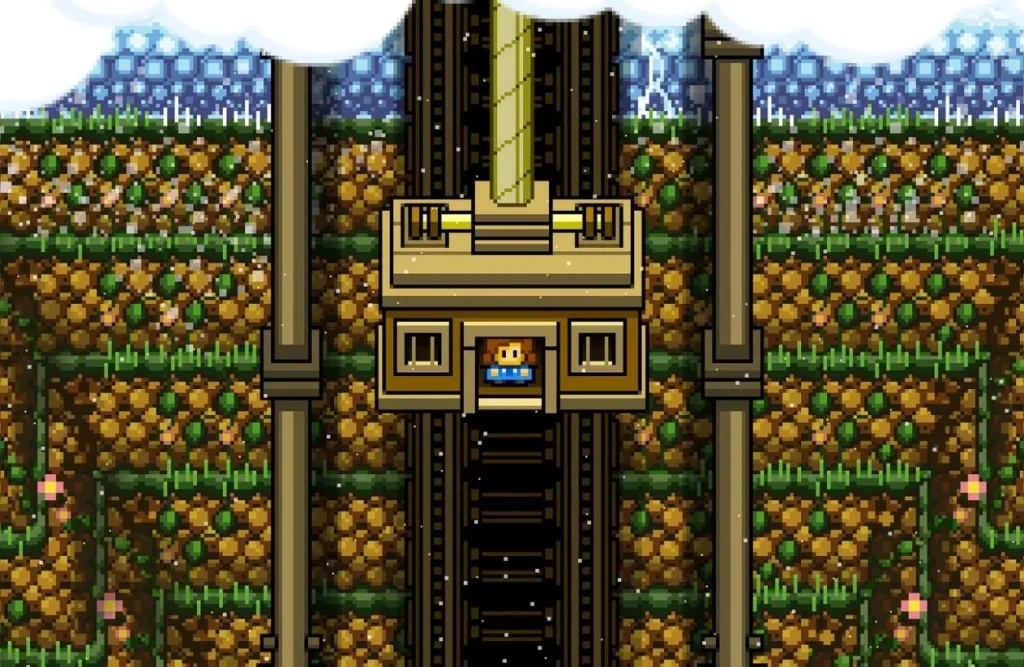
Some games try to hide their influences; Blossom Tales wears them like a badge of honor. This is arguably the most shameless—and charming—love letter to A Link to the Past ever made. From the spin attack to the pot-smashing physics, it feels like a lost SNES cartridge that you just happened to discover.
The game uses a framing device reminiscent of The Princess Bride, where a grandfather is narrating the adventure to his grandkids. This isn’t just flavor text; it actively changes the gameplay. If the kids complain that a section is too boring, the grandfather might suddenly drop a massive boss into the room or swap out enemies on the fly.
It removes the frustration of “ammo management” by using a recharging stamina bar for items (similar to A Link Between Worlds), keeping the action fluid. If you just want pure, unadulterated 16-bit nostalgia without any modern “bloat,” this is the palette cleanser you need.
Unique Twists on the Formula
7. Okami HD
Let’s be real: Okami isn’t just a game “like” Zelda—it’s widely considered the best Zelda game Nintendo never made. Originally released on the PS2, the HD remaster proves that its stunning sumi-e (ink wash) art style is timeless.
You play as Amaterasu, the sun goddess in the form of a white wolf, tasked with restoring beauty to a cursed feudal Japan.
The genius here is the Celestial Brush. Instead of collecting boomerangs or hookshots, you pause the world and draw shapes on the screen to cast spells. Draw a circle to make the sun rise, a slash to cut enemies, or a line to create a bridge.
It perfectly captures that “aha!” moment of using a new tool to solve an old puzzle, but with a tactile twist that feels completely unique. If you loved the dungeon-to-overworld rhythm of Twilight Princess or Ocarina of Time, this is your spiritual successor.
8. Outer Wilds
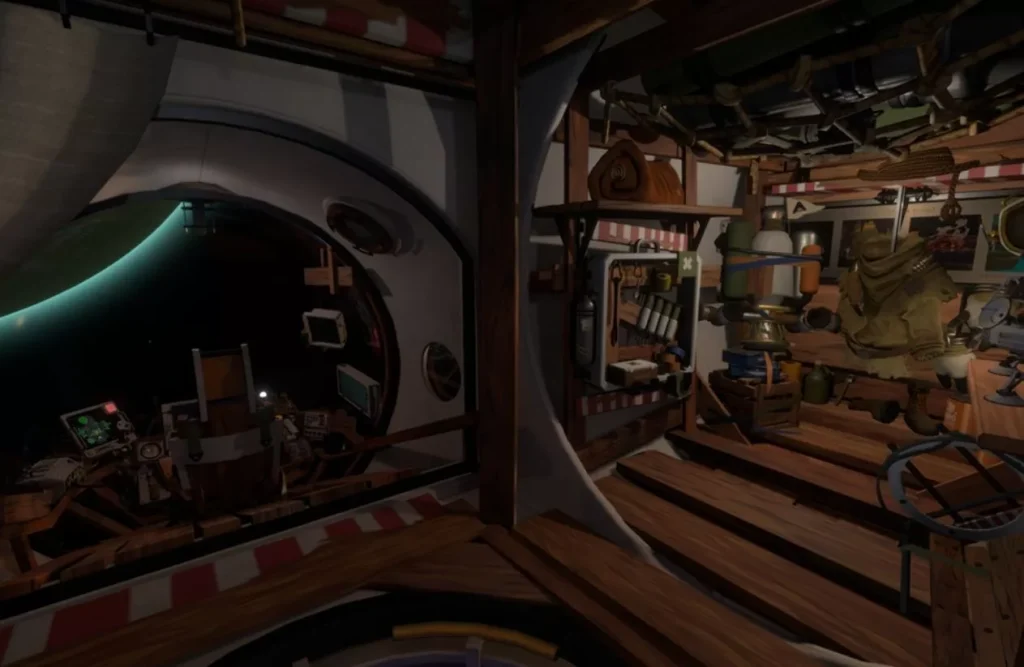
If you stripped a Zelda game of its combat and inventory, leaving only the pure, unadulterated thrill of discovery, you would get Outer Wilds. It’s a space exploration mystery that captures the exact feeling of stumbling upon a secret cave in Breath of the Wild, but scales it up to an entire solar system.
You play as an astronaut trapped in a 22-minute time loop. There are no upgrades, no heart containers, and no magic swords. The only thing you carry between loops is knowledge. That strange ruins you couldn’t enter?
You don’t need a key; you just need to read a translation on a different planet that explains how the door works. It’s a “Metroidvania of information” where the puzzles are logic-based and the “Aha!” moments are genuinely mind-blowing. If you play Zelda for the puzzles and the lore, this is non-negotiable.
9. Chicory: A Colorful Tale
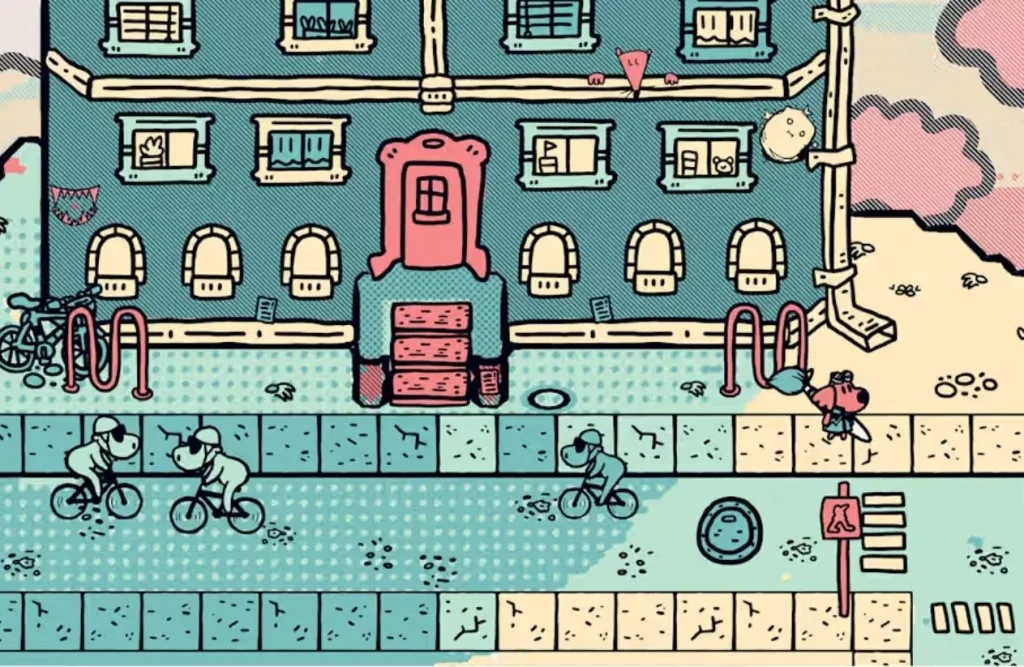
Don’t let the cute coloring-book aesthetic fool you—Chicory is a top-down Zelda adventure through and through. In a world where all colors have vanished, you play as a dog (named after your favorite food) who wields a magic paintbrush instead of a Master Sword.
The genius here is how the painting mechanic solves every problem. Need to climb a wall? Paint it to make the vines grow. Need to cross a gap? Paint the water to swim through it. It takes the environmental puzzle-solving of a classic Zelda dungeon and applies it to the entire overworld.
While it’s largely cozy, the boss encounters are surprisingly intense, shifting into creative “bullet hell” battles that test your reflexes. It’s a heartfelt story about imposter syndrome that feels like playing a living painting.
10. Hyper Light Drifter
Hyper Light Drifter is what happens when you take the skeleton of A Link to the Past, inject it with neon visuals, and crank the difficulty up to eleven. Set in a ruined, post-apocalyptic world, it completely abandons text boxes and dialogue. The entire story—the history of the titans, the plague infecting your character, the purpose of your journey—is told through the environment and the haunting soundtrack.
This “wordless” approach forces you to pay attention to every detail, capturing that genuine sense of mystery that defined the original NES Zelda. The combat, however, is much faster and more punishing.
You rely on a chain-dash ability to zip around arenas, slashing enemies and firing guns with pinpoint precision. It’s tough-as-nails and demands mastery, but for those who want a darker, moodier, and more challenging take on the top-down adventure, it is an absolute masterpiece.
Honorable Mentions
11. Sable
If you stripped Breath of the Wild of all its combat and left only the climbing, gliding, and pure discovery, you’d get Sable. With a stunning art style inspired by French comic artist Moebius, this game is a chill, meditative journey about a young girl’s rite of passage.
There are no enemies to fight here—just ancient ruins to scale, environmental puzzles to solve, and a hoverbike to customize. It captures the sheer joy of seeing a distant mountain and figuring out how to get to the top, but removes the stress of weapon durability or boss fights. It’s the ultimate “vibes” game for Zelda fans who just want to get lost in a beautiful desert.
12. Oceanhorn: Monster of Uncharted Seas
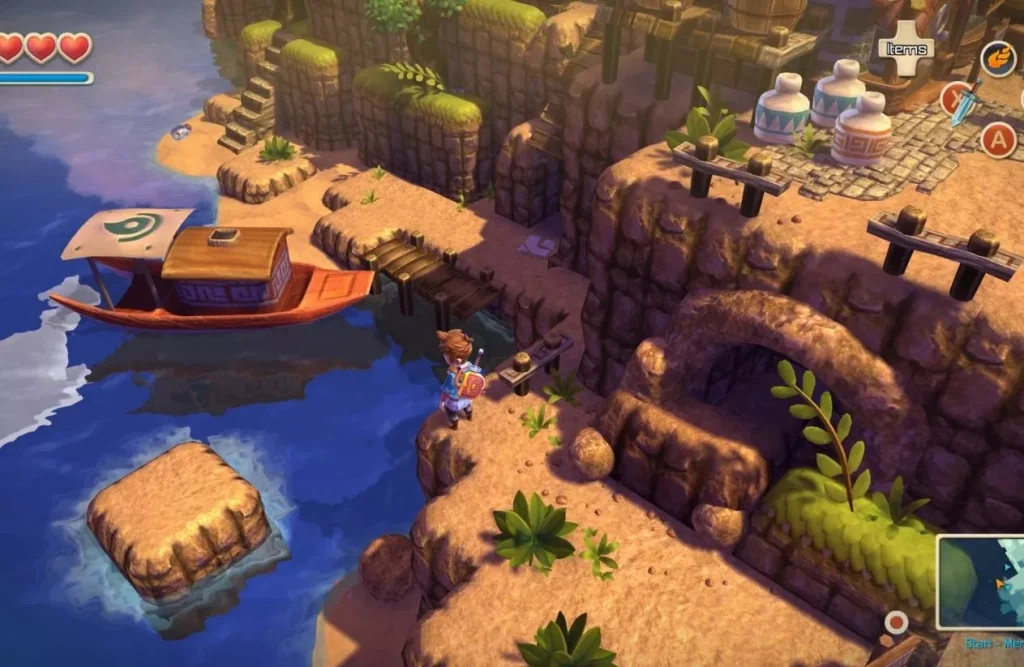
If Sable is the art-house cousin, Oceanhorn is the direct descendant that wears its inspiration on its sleeve. Visually and mechanically, it’s unapologetically borrowing from The Wind Waker. You sail a small boat between islands, solve block-pushing puzzles, and hack away at crabs and skeletons.
While it started as a mobile title, it transitioned beautifully to consoles. It lacks the deep complexity of a mainline Nintendo title, but as one of the most accessible Games Like The Legend of Zelda, it’s perfect for younger players or anyone craving a breezy, 10-hour adventure that feels like a greatest hits album of the genre’s tropes.
13. Darksiders: Warmastered Edition
Don’t let the skulls and apocalyptic grit fool you—Darksiders is arguably the most faithful 3D Zelda clone ever made; it’s essentially Ocarina of Time wearing a heavy metal t-shirt. You play as War, one of the Four Horsemen, but the gameplay loop is pure Nintendo.
You enter a dungeon, find a map and compass, fight a mini-boss to get a special item (like the “Crossblade” boomerang or “Abyssal Chain” hookshot), and then use that item to solve puzzles and defeat the main boss. The key difference is the combat, which borrows the visceral, combo-heavy action of God of War. If you ever wished Link could rip a demon’s arm off after solving a block puzzle, this is the mashup you didn’t know you needed.
Buyer’s Guide: Which One Should You Play First?
With so many options, picking a starting point can be paralyzing. To make it easy, here is a breakdown based on what specific part of the “Zelda DNA” you miss the most.
| If You Love… | Play This First | Why? |
|---|---|---|
| Mind-Bending Puzzles | Tunic or Outer Wilds | You want to feel smart and solve mysteries that require a notepad, not just reflexes. |
| Limitless Exploration | Elden Ring or Immortals Fenyx Rising | You crave that specific feeling of seeing a mountain on the horizon and knowing you can climb it. |
| Classic SNES Dungeons | Death’s Door or Blossom Tales | You miss the tight, top-down “lock-and-key” design of A Link to the Past. |
| Atmosphere & Vibes | Sable or Hyper Light Drifter | You care more about stunning art direction and environmental storytelling than complex RPG stats. |
| Anime & Elemental Magic | Genshin Impact | You want the physics systems of Breath of the Wild but with a deep character-collecting mechanic. |
Final Thoughts
Ultimately, the reason we keep looking for alternatives isn’t just because we finished the latest Nintendo release—it’s because the formula works. It taps into that primal urge to explore, to solve, and to conquer. While no single title can fully replace the magic of Hyrule, the industry is now rich with developers who understand exactly what makes those adventures tick.
Whether you’re decoding manual pages in Tunic or gliding off a cliff in Immortals, these titles prove that the spirit of Link lives on in new, exciting forms. So, grab your controller and pick one of these Games Like The Legend of Zelda; your next great memory is waiting to be made, and this time, you don’t even need a Master Sword to find it.
Also check our article: Best Games Like Persona 5